

Spending 18 years carefully building a college fund, only to discover your child earned a full scholarship, chose a trade career, or needed less than you saved — that used to mean a painful choice: pay steep penalties to access the money, leave it sitting unused, or redirect it to family members who might not need it.
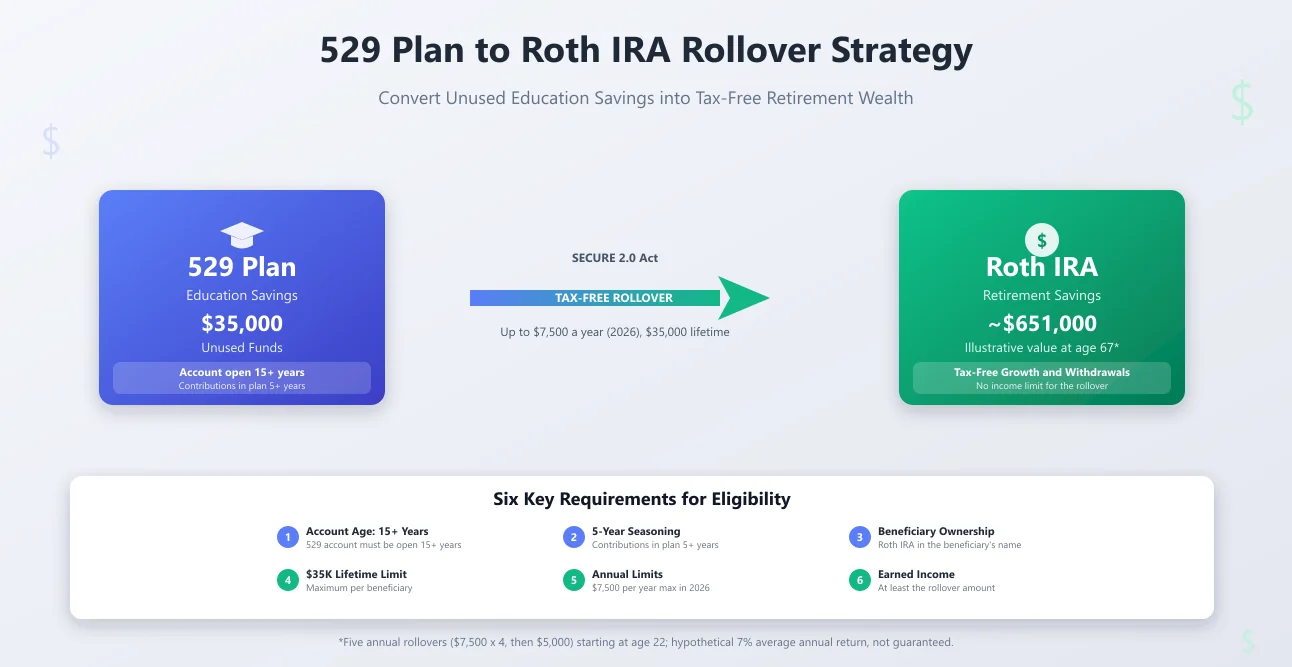
The SECURE 2.0 Act changed this in late 2022. For the first time, families can redirect substantial unused 529 funds directly into Roth retirement accounts without triggering the taxes and penalties that normally apply. Rolled over in annual installments starting at age 22, a seemingly modest $35,000 could grow to roughly $650,000 by age 67 at a hypothetical 7% average annual return — potentially tax-free retirement wealth, though returns aren’t guaranteed. But accessing this opportunity requires navigating 6 specific requirements that most families — and many advisors — don’t fully understand.
The 6 Eligibility Requirements
These are not arbitrary hurdles. Each reflects a specific tax policy goal. Understanding the reasoning behind each rule helps you plan more effectively.
| Rule | Requirement | Key Details | Common Pitfall |
|---|---|---|---|
| 1. Account age | The 529 account must have been open 15+ years | The clock starts when the account opens, not when you contribute | Beneficiary changes can reset the clock |
| 2. Contribution seasoning | Contributions (and their earnings) must have been in the 529 for 5+ years | Prevents using 529s as a short-term Roth backdoor | Recent contributions aren’t eligible yet |
| 3. Account ownership | The Roth IRA must be in the 529 beneficiary’s name, funded by direct trustee-to-trustee transfer | Parents cannot roll into their own Roth IRAs | Taking a check instead of a direct transfer |
| 4. Lifetime cap | $35,000 per beneficiary | Applies across all 529 accounts for that person | Underestimating long-term growth potential |
| 5. Annual limit | Cannot exceed the Roth IRA contribution limit, less any other IRA contributions that year | $7,500 for 2026 if under 50 ($7,000 in 2025) | Expecting an immediate lump-sum transfer |
| 6. Earned income | The beneficiary needs W-2 or self-employment income | The rollover can’t exceed that year’s earned income | Assuming college students have enough income |
No income limit applies: the usual Roth IRA phase-out doesn’t restrict 529-to-Roth rollovers (IRC §408A(c)(3)(E); requirements in IRC §529(c)(3)(E)).
Requirement 1: Account Maturity — The 15-Year Rule
The 529 account must have existed for at least 15 years before any rollover is eligible. The clock starts from the account opening date — not from when contributions were made, and not from when the account reached a certain balance.
Critical nuance: Changing the beneficiary on an existing account often resets the 15-year clock. This is one of the most common planning mistakes families make. Parents who move funds between siblings by changing beneficiaries may unknowingly destroy rollover eligibility that took years to develop.
Planning implication: Open separate accounts for each child rather than relying on beneficiary changes to redirect funds. Each account maintains its own independent 15-year timeline.
Requirement 2: Contribution Seasoning — The 5-Year Waiting Period
Contributions must sit in the 529 for at least 5 years before becoming rollover-eligible. This prevents families from contributing fresh money and immediately redirecting it to Roth accounts — which would turn the 529 into a quick pass-through into Roth accounts.
Contributions made today won’t be rollover-eligible for 5 years. Families who contribute consistently over many years will have multiple “vintage years” reaching eligibility at different points, providing ongoing flexibility for timing transfers.
Requirement 3: Account Ownership — The Roth IRA Must Be in Your Child’s Name
The Roth IRA receiving rollover funds must be in the beneficiary’s name — your child’s — not yours. You cannot redirect unused education savings into your own retirement accounts. If your child doesn’t already have a custodial Roth IRA open, that’s the first step before any rollover can happen.
This restriction is actually a wealth-building opportunity in disguise. Most young adults receive no meaningful retirement account funding until well into their careers. This rule mandates that you are providing early-career retirement savings for your child at the exact age when compound growth has its greatest long-term impact.
Requirement 4: Lifetime Limit — $35,000 per Beneficiary
The maximum lifetime rollover is $35,000 per beneficiary, regardless of how many 529 accounts they are associated with or how much sits in those accounts.
This limit applies across their entire lifetime — it is not an annual figure, and it cannot be reset.
Why $35,000 matters more than it looks:
| Age at First Rollover | Years to Age 67 | Illustrative Value at 67 |
|---|---|---|
| 22 | 45 | ~$651,000 |
| 25 | 42 | ~$531,000 |
| 30 | 37 | ~$379,000 |
The path for a first rollover at age 22:
| Age | Total Rolled Over | Illustrative Account Value |
|---|---|---|
| 30 | $35,000 | ~$53,000 |
| 40 | $35,000 | ~$105,000 |
| 50 | $35,000 | ~$206,000 |
| 60 | $35,000 | ~$405,000 |
| 67 | $35,000 | ~$651,000 |
These projections assume the $35,000 moves in five annual installments ($7,500 a year for four years, then $5,000), each at the start of the year, a hypothetical 7% average annual return and no other contributions. Actual returns vary and can be negative. Growth stays tax-free if withdrawals are qualified distributions. The earlier the transfers begin, the more compound growth amplifies the outcome.
Requirement 5: Annual Pacing — Capped at Roth IRA Contribution Limits
You cannot roll the full $35,000 in a single year. Annual rollover amounts are capped at the current Roth IRA contribution limit ($7,500 for individuals under 50 in 2026, up from $7,000 in 2025). At that rate, hitting the $35,000 lifetime maximum takes 5 years, with the final year needing only a partial $5,000 rollover to hit the cap.
This pacing requirement forces sustained coordination between the 529 account and your child’s career and income timeline — which leads directly to the most restrictive requirement.
Requirement 6: Earned Income — Equal to or Greater Than the Rollover Amount
For each year a rollover is executed, the beneficiary must have earned income equal to or greater than the amount being rolled over. Investment income, gifts, and passive income do not qualify.
| Child’s Earned Income | Maximum Rollover That Year |
|---|---|
| $0 (graduate student, unpaid intern) | $0 |
| $4,000 (part-time work) | $4,000 |
| $7,500+ | $7,500 (the annual cap) |
No earned income means no rollover eligibility — regardless of how much sits in the 529 or how old the account is.
Key planning implication: Summer jobs, part-time employment, freelancing, and entrepreneurial work during high school and college are not just income — they are future rollover eligibility. Every dollar of earned income creates a dollar of rollover capacity.
The Income Limit Bypass — A Significant Hidden Benefit
Under normal circumstances, high earners face Roth IRA contribution phase-outs based on adjusted gross income. Single filers above certain income thresholds are eventually prohibited from making direct Roth contributions entirely.
529-to-Roth rollovers are completely exempt from these income limits.
A young professional earning well above the normal Roth phase-out threshold is still eligible for 529 rollovers as long as they meet the 6 requirements above. For families investing heavily in their children’s education and career development, this creates a valuable Roth access pathway that would otherwise be unavailable to high earners.
Tax Treatment: Federal and State
Federal: Completely Tax-Free
529-to-Roth rollovers under SECURE 2.0 are treated as qualified rollovers between tax-advantaged accounts. No federal income taxes. No 10% early withdrawal penalty. The full transfer amount moves intact.
This contrasts sharply with non-qualified 529 withdrawals, which trigger both ordinary income tax and a 10% penalty on earnings.
State Tax Treatment: Varies Significantly
| State Category | States | Tax Treatment |
|---|---|---|
| Follows federal — no recapture | Alabama, Arizona, Delaware, Georgia, Hawaii, Idaho, Kansas, Kentucky, Maine, Maryland, Nebraska, New Mexico, North Carolina, North Dakota, Ohio, Oregon, Pennsylvania, South Carolina, Virginia, West Virginia, Wisconsin | Rollovers are tax-free; no recapture of prior state deductions |
| Requires recapture of prior deductions | Illinois, Indiana, Iowa, Massachusetts, Michigan, Minnesota, Montana, New York, Utah, Vermont | Prior state deductions for 529 contributions must be added back to state taxable income |
| No state income tax | Alaska, Florida, Nevada, New Hampshire, South Dakota, Tennessee, Texas, Washington, Wyoming | State tax irrelevant |
| California — additional state tax | California | Treats rollovers as non-qualified withdrawals AND imposes an additional 2.5% state tax on the earnings portion |
| Pending or unclear | Arkansas, Colorado, Connecticut, Louisiana, Mississippi, Missouri, New Jersey, Oklahoma, Rhode Island, DC | Position not yet announced; consult a local tax professional |
Virginia example: Residents can claim up to $4,000 in annual state tax deductions for 529 contributions and still execute rollovers without recapture. No repayment of the original state tax benefit required.
California example: The 2.5% additional state tax makes California the least favorable state for this strategy, though federal benefits may still justify execution depending on the account balance and the individual’s tax situation.
Who Benefits Most: 4 Family Scenarios
| Scenario | Why It Works Well | Rollover Potential | Key Considerations |
|---|---|---|---|
| Full scholarship recipient | Large unused balance available | High | May still need some funds for costs the scholarship doesn’t cover |
| Trade school choice | Lower education costs, earlier workforce entry | High | Earned income starts earlier, which supports annual rollovers |
| Strategic over-saver | Planned excess funds for wealth building | Medium | Requires long-term family planning; only contributions older than 5 years qualify |
| Graduate school funded separately | Undergraduate costs covered, surplus remains | Medium | No income limit applies, so a high-earning graduate can still roll over |
| Late career change | Adult child never used the education funds | Medium | The account is usually well past 15 years, but the $35,000 lifetime cap limits how much of a large balance can move |
| Multiple children, different paths | Flexibility to redirect between beneficiaries | Medium | Beneficiary changes can reset the 15-year clock |
Scenario 1: The Scholarship Family
A family saved $150,000 for a child’s education. Scholarship awards cover $100,000 of actual costs. The remaining $50,000 represents successful planning that exceeded expectations — not a waste.
Through rollover planning, up to $35,000 of those excess funds can begin generating tax-free retirement wealth. The remainder can be redirected to other family members, held for graduate school, or withdrawn subject to standard penalty rules.
Scenario 2: The Alternative Path
A child chooses a trade school, apprenticeship, or direct workforce entry instead of a traditional 4-year degree. Costs are far lower than anticipated, leaving substantial 529 balances available.
The narrative shifts: this is not money wasted on a plan that changed. It is education savings that funded career flexibility — and can now fund retirement security.
Scenario 3: The Prudent Over-Saver
Consistent contributions over many years, combined with strong investment returns, produce a 529 balance that exceeds reasonable education cost estimates. Rather than treating this as a planning error, it can be structured as the first stage of a multi-generational wealth building strategy.
Scenario 4: The High-Earning Child
A child who earns above the normal Roth IRA income phase-out thresholds gains access to Roth benefits through the rollover pathway that would otherwise be unavailable. The more professionally successful the child becomes, the more valuable this tax-free transfer becomes — because they face higher marginal rates and fewer alternative Roth access options.
Common Implementation Mistakes
Mistake 1: Miscounting the 15-year clock
Many families discover too late that a beneficiary change or account restructuring reset the timeline. Maintain documentation of the original account opening date and avoid unnecessary beneficiary modifications.
Mistake 2: Assuming earned income will always be available
Demanding academic programs, unpaid internships, and graduate school years can produce low or zero earned income years. A student with no earned income in a given year has zero rollover eligibility that year, regardless of how much sits in the 529. Plan for income gaps and front-load rollovers during high-income years.
Mistake 3: Forgetting to coordinate with direct Roth contributions
Rollover amounts count toward the annual Roth IRA contribution limit. If your child is already making Roth contributions from employment income, those reduce the rollover capacity for the same year. Track both sources together.
Mistake 4: Ignoring state tax recapture requirements
Families in recapture states who don’t account for state-level consequences may face unexpected state income tax bills. Model the state tax cost alongside the federal benefit before executing.
Mistake 5: Multi-state contribution history
Families who lived in multiple states during their savings years may face complex allocation questions. A family that claimed Virginia deductions for 10 years, then moved to Massachusetts for 5, needs to understand how to allocate rollovers across contributions made under different state tax regimes.
Implementation Strategy
Phase 1: Foundation Building (Birth Through High School)
| Action | Why It Matters |
|---|---|
| Open accounts early, ideally at or near birth | Starts the 15-year clock immediately |
| Open separate accounts per child | Avoids beneficiary changes that reset the clock |
| Contribute consistently, even small amounts | Creates multiple “vintage years” of 5-year-seasoned funds |
| Encourage part-time work and entrepreneurial activity | Builds earned income record for future rollover eligibility |
Phase 2: Active Rollover Period (Early Career)
| Action | Why It Matters |
|---|---|
| Verify 15-year account eligibility | Confirm clock was never reset by beneficiary changes |
| Confirm 5-year seasoning on specific contributions | Newer contributions are not yet eligible |
| Coordinate with child’s earned income each year | Rollover cannot exceed that year’s earned income |
| Track against annual Roth contribution limit | Direct Roth contributions reduce rollover capacity |
| Model state tax consequences | Especially critical in recapture states and California |
Phase 3: Coordination with Broader Financial Goals
A qualifying rollover isn’t a Roth conversion and isn’t taxed, so the beneficiary’s tax bracket doesn’t change its cost. What limits timing is earned income: each year’s rollover can’t exceed that year’s earned income or the annual Roth IRA limit. Coordinate with employer 401(k) matching opportunities, as maximizing matching contributions before pursuing rollovers typically produces better overall outcomes. Consider how rollovers interact with major life transitions such as home purchases, graduate school funding, and marriage.
Annual Rollover Pacing Example
Assuming a 22-year-old beneficiary with consistent earned income of $7,500+ per year:
| Year | Annual Rollover | Cumulative Total | Years Until $35K Lifetime Max |
|---|---|---|---|
| Year 1 | $7,500 | $7,500 | 5 years total |
| Year 2 | $7,500 | $15,000 | |
| Year 3 | $7,500 | $22,500 | |
| Year 4 | $7,500 | $30,000 | |
| Year 5 | $5,000 (partial) | $35,000 | Maximum reached |
Assuming a hypothetical 7% annual return, the Year 1 transfer alone would be worth about $9,830 by the time the Year 5 transfer is made four years later — before a single dollar of that final transfer has compounded at all.
Evaluating Whether This Strategy Fits Your Family
| Factor | Favors This Strategy | Works Against It |
|---|---|---|
| 529 account age | Account opened 15+ years ago | Account opened recently |
| Unused balance | Significant balance relative to remaining education costs | Funds still needed for education |
| Child’s career path | Earning income in early career | Graduate school, low-income years ahead |
| State of residence | No-recapture state or no income tax state | California or recapture state |
| Planning horizon | Comfortable with multi-year execution | Prefer simpler, immediate solutions |
| Asset control preference | Comfortable transferring assets to child’s name | Prefer maintaining centralized control |
| Organization and recordkeeping | Strong documentation systems | Difficulty maintaining long-term records |
The Broader Picture: Multi-Generational Wealth Implications
Roth IRAs have no required minimum distributions during the owner’s lifetime. Assets can continue growing tax-free indefinitely. Upon the owner’s death, the account passes to beneficiaries, and qualified distributions to them are generally tax-free. A surviving spouse can treat the Roth IRA as their own, but most other beneficiaries must empty it by the end of the 10th year after the year of death. Only eligible designated beneficiaries — the owner’s minor children, disabled or chronically ill beneficiaries, and anyone not more than 10 years younger than the owner — can stretch distributions over their life expectancy (Pub. 590-B).
Rolling over $35,000 starting at age 22 is not just a retirement account contribution. It is the seed of a financial asset that, if left largely intact, can span multiple generations. Most young adults never receive meaningful retirement account funding until their 30s or 40s. A Roth IRA established in their early 20s through a 529 rollover can give them a decade or more of extra compounding compared with a first retirement contribution in their 30s — a head start that cannot be replicated later regardless of how much they save.
Key Takeaways
| Rule | The Requirement |
|---|---|
| Account age | 529 must be at least 15 years old |
| Contribution seasoning | Money must be in the account for at least 5 years |
| Account ownership | Roth IRA must be in the beneficiary’s name |
| Lifetime cap | $35,000 per beneficiary, across all rollovers, ever |
| Annual pacing | Limited to the current Roth IRA contribution limit per year |
| Earned income | Beneficiary must have earned income equal to or greater than the rollover amount |
| Income limits | None — high earners qualify regardless of AGI |
| Tax treatment (federal) | Completely tax-free |
| Tax treatment (state) | Varies — research your specific state before executing |
Use our retirement savings calculator to model how a rollover compounds over your child’s career.
Frequently Asked Questions
Can I roll over funds from multiple 529 accounts for the same child?
Yes — the $35,000 lifetime cap applies per beneficiary, not per account. If a child has 529 accounts from both parents and grandparents, all rollovers count against the same $35,000 limit, but you can draw from whichever accounts are most advantageous (e.g., prioritizing the oldest account if others haven’t hit the 15-year mark yet).
What if I change the 529 beneficiary to a sibling — does the 15-year clock reset for both accounts?
Only the account whose beneficiary changed resets. If Account A (originally for Child 1) is changed to name Child 2 as beneficiary, Account A’s 15-year clock resets for rollover purposes involving Child 2. A separate account that was always in Child 2’s name is unaffected.
Can grandparent-owned 529 accounts use this rollover?
Yes, as long as the account meets the same 15-year and 5-year requirements and the receiving Roth IRA is in the beneficiary’s (grandchild’s) name. Account ownership doesn’t have to match Roth IRA ownership — only the 529 beneficiary and the Roth IRA owner need to be the same person.
Does the rollover count as taxable income to the beneficiary?
No. A qualifying 529-to-Roth rollover is federally tax-free and doesn’t appear as income on the beneficiary’s tax return, which also means it doesn’t affect their ability to claim other credits or deductions tied to income limits that year.
What if my state doesn’t have guidance on this yet?
Treat it cautiously — file as if recapture could apply, or consult a tax professional in your state before executing a large rollover. States listed as “pending or unclear” in the table above may issue guidance that changes the tax treatment retroactively, so documentation of your original state tax deductions is worth keeping regardless.
This article is for educational and informational purposes only and should not be construed as personalized financial, tax, or legal advice. Tax laws are complex and subject to change. The SECURE 2.0 provisions discussed here may be modified by future legislation, and state tax treatment continues to evolve as states issue guidance. Consult a qualified tax professional, CPA, enrolled agent, or financial advisor who can evaluate your specific situation before implementing any strategy discussed in this article.