

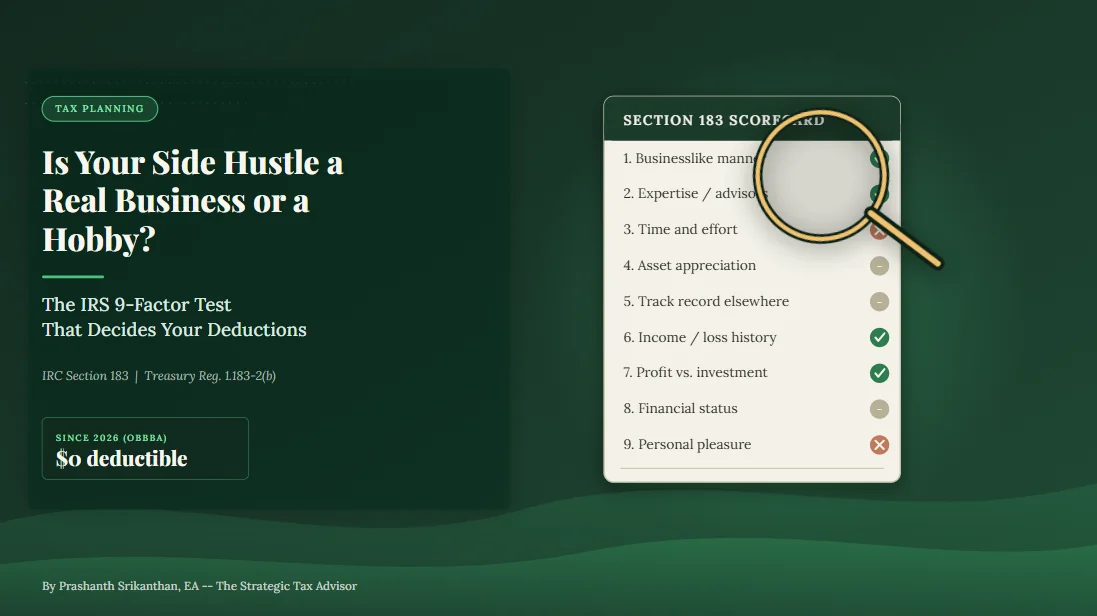
The short answer: The IRS treats a side activity as a hobby when it isn’t carried on to make a profit. An activity that shows a profit in 3 of the last 5 years (2 of 7 for horse activities) is presumed to be a business. Otherwise, the IRS weighs nine factors from Treasury Regulation §1.183-2(b), including how businesslike the activity is, your expertise, the time you put in, and your history of income and losses. The stakes are higher now: under IRC §67(h), made permanent by the One Big Beautiful Bill Act, hobby expenses can’t be deducted at all, while hobby income must still be reported.
If you run a side business that has posted a loss more than once, one IRS provision decides whether those losses are worth anything on your tax return: IRC Section 183, commonly called the “hobby loss” rule.
Most articles on this topic mention it in passing. This one does not. Below is the actual 9-factor test the IRS and the Tax Court use, in the order the regulation lists them, with a self-scoring table you can apply to your own activity today.
Why This Rule Matters More in 2026 Than It Did in 2025
Before 2018, if the IRS decided your activity was a hobby, you could still deduct hobby expenses up to the amount of hobby income, as a miscellaneous itemized deduction subject to a 2% of AGI floor. It was a consolation prize, but it was something.
The Tax Cuts and Jobs Act suspended that deduction for 2018 through 2025, and the One Big Beautiful Bill Act made the suspension permanent. That means taxpayers cannot deduct any hobby expenses going forward, full stop.
| Period | Hobby Expense Treatment |
|---|---|
| Before 2018 | Deductible up to hobby income, subject to 2% of AGI floor |
| 2018 to 2025 (TCJA) | Fully suspended, $0 deductible |
| 2026 onward (OBBBA) | Permanently eliminated, $0 deductible, no reversion date |
The consolation prize is gone. If your side business gets reclassified as a hobby today, you report 100% of the income and deduct 0% of the expenses. There is no partial credit anymore. That is the reason this test deserves more attention than a single throwaway paragraph in a general side-hustle article.
What Section 183 Actually Says
IRC Section 183 disallows deductions for any activity “not engaged in for profit.” An activity is presumed to be engaged in for profit, and gets favorable treatment automatically, under one narrow safe harbor:
The 3-of-5 Year Presumption
If an activity produces gross income exceeding its deductions for 3 or more of the last 5 tax years, it is generally presumed to be for-profit. (Horse breeding, racing, showing, or training gets a more forgiving 2-of-7 year window.)
If you clear that bar, you generally do not need to worry about the rest of this article. If you do not, and most legitimate early-stage businesses do not because startup losses are normal, the IRS falls back to the 9-factor facts-and-circumstances test in Treasury Regulation Section 1.183-2(b).
The 9-Factor Test
No single factor is determinative. The regulation supports a wide-ranging qualitative analysis, and a numerical majority of factors on one side does not decide the issue on its own. The list is not exhaustive either — examiners can weigh anything relevant to intent.
| # | Factor | What the IRS Is Actually Looking For |
|---|---|---|
| 1 | Manner of carrying on the activity | Whether you operate it the way a real business would. This is typically the most heavily weighted factor. |
| 2 | Expertise of the taxpayer or advisors | Did you study the field, consult experts, or just wing it? |
| 3 | Time and effort expended | Serious hours committed signal a profit motive, not casual hours |
| 4 | Expectation that assets will appreciate | Even without current profit, expected appreciation of business assets like land can support a profit motive. |
| 5 | Success in other similar or dissimilar activities | A track record of turning other ventures profitable, especially similar ones, counts in your favor. |
| 6 | History of income or losses | Your own multi-year track record of income and losses in this specific activity. |
| 7 | Amount of occasional profits | The size of profits relative to losses, and relative to your investment and asset value, is a useful signal of intent. |
| 8 | Financial status of the taxpayer | Having substantial income from other sources does not automatically disqualify an activity from being for-profit, but it can suggest the activity is a hobby if losses conveniently offset a high-earning day job. |
| 9 | Elements of personal pleasure or recreation | Personal enjoyment can indicate a hobby, but the regulation is explicit that an activity does not have to be run with the exclusive intention of making a profit to qualify. |
Self-Scoring Checklist
Score each factor honestly. This will not hold up in an actual exam, but it will show you where your file is thin before the IRS finds out for you.
| Factor | Strong Evidence (2 pts) | Weak Evidence (1 pt) | No Evidence (0 pts) |
|---|---|---|---|
| 1. Businesslike manner | Separate bank account, bookkeeping software, written business plan | Some records, no formal plan | Personal account used for business |
| 2. Expertise | Industry certification, paid consultants, formal training | Self-taught, some research | No relevant background |
| 3. Time and effort | 20+ hours per week, documented | A few hours per week | Sporadic, undocumented |
| 4. Asset appreciation | Owns appreciating business assets (real estate, IP, equipment) | Some depreciating equipment only | No meaningful assets |
| 5. Track record elsewhere | Prior ventures turned profitable | Mixed history | No prior ventures |
| 6. Income and loss history | Losses narrowing year over year | Flat losses | Losses widening year over year |
| 7. Profit relative to investment | Occasional real profit years | Break-even years | Losses every year since inception |
| 8. Financial status | Activity is a meaningful income source | Moderate reliance | High W-2 income, losses offset that income every year |
| 9. Personal pleasure | Activity is objectively unpleasant work | Neutral | Activity is a stated hobby, sport, or passion project |
18 points or higher: Strong for-profit position, well documented. 10 to 17 points: Defensible, but tighten the weak categories before your next filing. Below 10 points: High hobby-reclassification risk. This is where a real conversation about restructuring the activity belongs.
A Worked Example
Consider a photographer who left a corporate job, spends 30 hours a week shooting weddings, keeps a dedicated business checking account and QuickBooks file, invested $18,000 in camera equipment, and has posted losses of $4,000, $3,200, and $2,100 in each of the last 3 years while revenue grew each year.
| Factor | Assessment |
|---|---|
| Manner | Businesslike (separate accounts, bookkeeping) |
| Expertise | Strong (former career, ongoing training) |
| Time | Substantial (30 hrs/week) |
| Asset appreciation | Neutral (equipment depreciates) |
| Track record | Neutral (first venture) |
| Income and loss history | Favorable (losses narrowing, revenue growing) |
| Profit relative to investment | Favorable trend |
| Financial status | Neutral (no other job to offset) |
| Personal pleasure | Unfavorable (photography is her stated passion) |
Net read: this activity would very likely survive a hobby-loss challenge despite the personal-enjoyment factor, because the trend line on income, the businesslike operation, and the expertise factor all point the same direction. Compare that to a corporate executive earning $400,000 a year who spends 5 hours a week on a photography “business” that has lost money every year for 6 years with no separate books. Same activity, opposite outcome, because factors 1, 3, 6, 7, and 8 all flip.
How to Build a Defensible File Before You Ever Need It
- Open a separate business bank account and credit card. This single step touches Factor 1 and is the fastest credibility gain available.
- Write a one-page business plan with revenue targets. Update it annually. This document alone addresses Factors 1, 2, and 6.
- Track hours. A simple spreadsheet log addresses Factor 3 directly and costs nothing to maintain.
- If losses are structural, document why. Equipment purchases, marketing spend, or a deliberate multi-year ramp should be explained in writing at the time, not reconstructed later.
- Revisit pricing and offerings if losses persist past year 3 or 4. A documented pivot, such as raising rates or cutting an unprofitable service line, is itself evidence of profit motive under Factor 1.
- Consider entity structure once revenue is consistent. An LLC or S-corp does not by itself win a hobby-loss argument, but it reinforces Factor 1 by forcing separate books, formal registration, and (for an S-corp) payroll.
- Reconcile 1099-K forms from payment apps against your books. If clients pay you through Venmo, PayPal, or a similar platform, the 1099-K you receive needs to match the income you’re already reporting — a mismatch is one of the easiest ways to draw exactly the kind of scrutiny this test is meant to survive.
Frequently Asked Questions
Does forming an LLC automatically protect me from hobby loss reclassification? No. Entity formation supports Factor 1 but is not determinative on its own. The IRS and Tax Court look at how the activity actually operates, not just how it is titled.
How many loss years is too many? There is no fixed number outside the 3-of-5 presumption. Courts have allowed startup losses lasting well beyond 5 years where the taxpayer showed a genuine, escalating effort to reach profitability. The direction of the trend line matters more than the raw count of loss years.
Can a new business postpone the IRS’s hobby-or-business decision? Yes. Under IRC §183(e), a new activity can file Form 5213 to postpone the determination until the end of its fifth year (seventh for horse activities). If it shows a profit in 3 of those 5 years (2 of 7 for horses), the presumption covers the whole period. The trade-off: the election also extends the time the IRS has to assess tax for those years.
If I am reclassified as a hobby, do I still owe self-employment tax? No. Hobby income is reported as other income and is not subject to self-employment tax, but it is also not eligible for the Section 199A qualified business income deduction or any business expense offset.
Can I claim cost of goods sold even if my activity is ruled a hobby? Yes, if the hobby involves selling goods, the direct cost of producing those goods can still reduce the income reported, even though other expenses cannot.
Track your business expenses with our business deduction tracker, and if you’re ready to formalize the activity, see our business entity formation guidance.
Sources
- IRC §183, Activities not engaged in for profit, including the 3-of-5-year presumption in §183(d)
- Treasury Regulation §1.183-2, Activity not engaged in for profit defined, the nine factors in §1.183-2(b)
- IRC §67, 2-percent floor on miscellaneous itemized deductions, whose §67(h) suspension was made permanent by Pub. L. 119-21, §70110
- IRS Fact Sheet FS-2022-38, Know the difference between a hobby and a business
- IRS, About Form 5213, Election to postpone determination as to whether the presumption applies
- IRS Publication 525, Taxable and Nontaxable Income
This article is for general informational purposes and does not constitute tax, legal, or accounting advice for any specific situation. Consult a qualified tax professional before making decisions based on this content.